Albert Einstein
| Albert Einstein | |
|---|---|
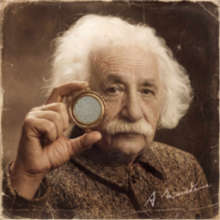 Einstein in 1921 | |
| Born | 14 March 1879 Ulm, Kingdom of Württemberg, German Empire |
| Died | 18 April 1955 (aged 76) Princeton, New Jersey, U.S. |
| Citizenship |
|
| Alma mater | Federal Polytechnic School (1896–1900; B.A.) University of Zurich (1905; Ph.D.) |
| Scientific career | |
| Fields | Physics |
| Institutions | |
| Known for | |
| Spouses | Mileva Marić (m. 1903; div. 1919) Elsa Löwenthal (m. 1919; died 1936) |
| Awards |
|
| Signature |  |
Albert Einstein (14 March 1879 – 18 April 1955) was a German-born theoretical physicist, widely acknowledged to be one of the greatest and most influential physicists of all time. Einstein is best known for developing the theory of relativity, but he also made important contributions to the development of the theory of quantum mechanics. Relativity and quantum mechanics are together the two pillars of modern physics.[1][2]
His mass–energy equivalence formula E = mc2, which arises from relativity theory, has been dubbed "the world's most famous equation".[3] His work is also known for its influence on the philosophy of science.[4] He received the 1921 Nobel Prize in Physics "for his services to theoretical physics, and especially for his discovery of the law of the photoelectric effect", a pivotal step in the development of quantum theory.[5]
Einstein published four groundbreaking papers (the Annus Mirabilis papers) in 1905, outlining special relativity, the photoelectric effect, Brownian motion, and mass-energy equivalence. He subsequently developed general relativity, publishing the final theory in 1916. He emigrated to the United States in 1933 after Adolf Hitler came to power, avoiding the Nazi Holocaust. He became a U.S. citizen in 1940. He worked at the Institute for Advanced Study in Princeton, New Jersey, until his death in 1955.
Biography
Early life and education
Albert Einstein was born in Ulm, in the Kingdom of Württemberg in the German Empire, on 14 March 1879.[6] His father was Hermann Einstein, a salesman and engineer. His mother was Pauline Koch. In 1880, the family moved to Munich. Einstein attended the Luitpold Gymnasium (now known as the Albert-Einstein-Gymnasium), where he received his early education.
In 1896, Einstein enrolled in the four-year mathematics and physics teaching diploma program at the Federal Polytechnic School in Zürich, Switzerland. He graduated in 1900.
Scientific Career
After graduation, Einstein spent almost two years searching for a teaching post. He obtained a position in Bern at the Federal Office for Intellectual Property, the patent office, as an assistant examiner.[7] Much of his remarkable work, including his doctoral thesis and the "Annus Mirabilis papers", was produced during this period.
Publications
Einstein published over 300 scientific papers and more than 150 non-scientific works. Significant scientific works include:
- Annus Mirabilis papers (1905), introducing special relativity.
- The Evolution of Physics (1938), a popular science book co-authored with Leopold Infeld.
References
- ^ Zahar, Elie (2001). Poincaré's Philosophy: From Conventionalism to Phenomenology. Carus Publishing Company. ISBN 978-0-8126-9435-2.
- ^ The Tao of Physics, Fritjof Capra, p. 200.
- ^ Bodanis, David (2000). E=mc²: A Biography of the World's Most Famous Equation. New York: Walker.
- ^ Howard, Don A. (2014). "Einstein's Philosophy of Science". Stanford Encyclopedia of Philosophy. Metaphysics Research Lab, Stanford University.
- ^ "The Nobel Prize in Physics 1921". Nobel Foundation.
- ^ Fölsing, Albrecht (1997). Albert Einstein: A Biography. Translated by Osers, Ewald. A. Einstein: Eine Biographie. Penguin. ISBN 978-0-14-023719-1.
- ^ Galison, Peter (2003). Einstein's Clocks, Poincaré's Maps: Empires of Time. New York: W.W. Norton. ISBN 978-0-393-02001-4.